


 David Kimathi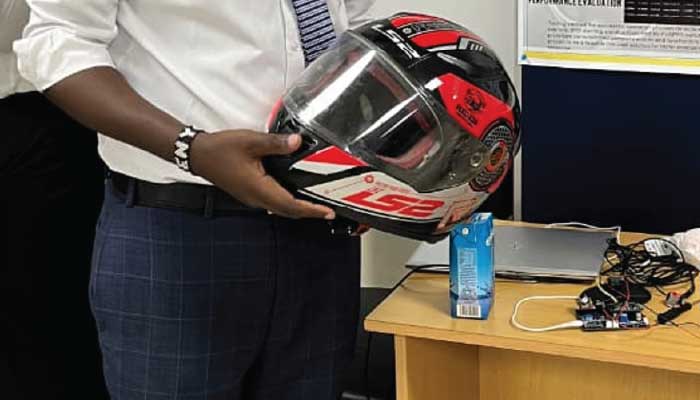
Imagine scrolling through your social media feed and suddenly coming across a post asking people to help identify an accident victim. It could be your sibling, parent, partner, or friend. Someone was cycling or riding a motorbike, and now strangers are trying to trace their family and identify the hospital where they were taken. In moments like these, one question quietly lingers: who or what would speak on your behalf if you were involved in a serious accident in the middle of nowhere? Your phone? Your watch? Your bracelet? Or perhaps a helmet for a nduthi rider (motocyclist)?
For Samuel Wairegi, a Bachelor Of Science In Electrical and Electronics Engineering student at the School of Computing and Engineering Sciences(SCES), awaiting graduation this August, a helmet can become something more: a lifeline. Through his final year project, Crush Sense, Wairegi has designed a smart helmet system capable of detecting accidents, monitoring a rider’s condition, and alerting emergency responders in real time.
At its heart, the innovation addresses a painful reality: many accident victims lose critical minutes waiting for help. As Samuel puts it, “Crush Sense is a smart helmet system that speaks when you cannot.”
For him, the problem was both personal and visible. As someone who enjoys riding motorbikes, Samuel had witnessed the vulnerability riders face every day and noticed a recurring pattern after accidents. “Many riders and people usually find themselves in accidents, and in that situation there is confusion and commotion. You mostly depend on people passing by for medical assistance or even to notify your family,” he explains.
Crush Sense changes that process. Once the system detects an accident, it automatically sends text messages to emergency contacts, medical responders, and authorities with the victim’s location and health information. “The system detects an accident, it sends a message to your next of kin and medical responders. Other than that, it still sends your pulse, heartbeat and oxygen level so that medical practitioners know what is going on before they even arrive,” he says.
The technology combines hardware and software into a fully integrated emergency response system. Built around an ESP32 microcontroller with Wi-Fi capability and a GSM SIM card, the helmet also incorporates GPS tracking and health sensors similar to those found in smartwatches. “The system has what we call an SpO2 sensor, it can calculate your heartbeat and oxygen concentration,” he explains.

Crush Sense Dashboard
Users register through a web application where they input emergency contacts and personal details linked directly to the helmet. From the web app, users can input their next of kin information. For now I have set it to around three contacts, but it can be expanded further,” he says.
The GPS functionality ensures that responders receive not only an alert but also the rider’s precise coordinates through a Google Maps link. Wairegi also designed the system with accessibility in mind. “For people without smartphones, it still sends an SMS with the Google Maps link and location details. The main purpose is making sure people know where you are and can take action immediately,” he explains.
Powering such a system presented another challenge. Riders often travel long distances and may not always have access to charging facilities. Samuel addressed this by incorporating multiple charging solutions. “The helmet has an embedded battery and solar charging. You can charge it on the go and it also has a backup battery and USB charging at home. If the battery goes below 15 percent, it can send you a notification reminding you to charge it,” he says.
The inspiration came from more than engineering curiosity. He was motivated by the frequency of motorcycle accidents and delayed emergency response. “Research shows many deaths occur due to delayed emergency response,” he explains, reflecting on the broader social cost of these accidents. “Many youths are the ones driving motorbikes, and they actively contribute to the economy, losing them through accidents affects future generations,” he says.
Building Crash Sense, however, was not without obstacles. Cost became one of his biggest engineering puzzles. “Finding the exact components that would fit my budget and still solve the problem was a challenge,” he says. Affordability became central to his thinking, especially considering the people he hopes to serve.
Like many engineering projects, technical setbacks also became part of the journey. “You write firmware and it doesn’t give the response you need,” he recalls.
The prototype has already undergone testing with promising results. Wairegi simulated impact conditions to evaluate whether the system could detect accidents and trigger emergency responses. “I tested the helmet and it really worked. It sent me an SMS,” he says excitedly.

Sample text message
For Wairegi, Crush Sense may begin with motorbikes, but he sees possibilities beyond helmets. “The same hardware can be installed in cars and detect accidents, wearable devices like watches for emergency situations,” he explains.
Now, as he looks beyond university, his focus has shifted from building to scaling. “I’m interested in anyone who can mentor me in marketing or pitching,” Wairegi says. “I need people who can help bring this solution to the market.” Are you one of these people?
Reflecting on his time at Strathmore University, Samuel credits the institution for shaping his mindset as an engineer. “We were taught to see problems in society and bridge those gaps,” he says.
He also acknowledges the people who supported him, including his supervisor Mr. Malack Oteri, overall supervisor Dr. Shamil Omar, and his friends Keith Brian and Emanuel Lekatoo. “Projects cannot be done alone,” he says.
For younger students hoping to build solutions of their own, Samuel offers simple advice: “Start early. Be alert. Write everything down!”
His vision remains clear: creating technology that saves lives before it is too late. “We always anticipate the best while expecting the worst. At least if something happens, there should be something to speak up for you” Wairegi says.
And perhaps that is what makes Crush Sense more than a final year project. It is a reminder that innovation is not just about smarter technology. Sometimes, it is about giving people a voice when they need it most.
“Resilience and not giving up helped me through everything.”
Article written by Nekesa Teresa