


 Brian Kiprotich
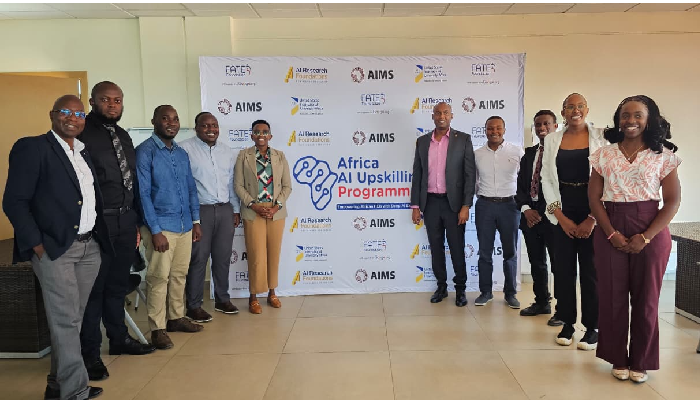
Selected among six Kenyan universities for the Africa AI Upskilling Programme, Strathmore University is preparing to equip educators and students with the skills to move beyond using artificial intelligence to understanding, developing and shaping it.
The artificial intelligence revolution is gathering pace. Algorithms are reshaping industries, redefining professions and transforming how societies learn, work and solve problems. Yet, amid this technological upheaval, an uncomfortable question confronts Africa. Will the continent merely consume technologies developed elsewhere, or will it have the knowledge, talent and capacity to shape its own AI future?
For Strathmore University, the answer begins in the classroom. Through its School of Computing and Engineering Sciences (SCES), the University has been selected as one of six Kenyan institutions to participate in the Google.org-funded Africa AI Upskilling Programme, an ambitious initiative designed to strengthen artificial intelligence education and empower African universities to develop homegrown technological expertise.
The programme, administered by Nigeria’s FATE Foundation and the African Institute for Mathematical Sciences (AIMS) South Africa, seeks to reach 30 universities across Kenya, Ghana, Nigeria and South Africa by 2028.
For Strathmore, however, this is an investment in the people who will teach, develop and ultimately shape the technologies of tomorrow.
At the heart of the initiative is the aim to transform AI education by empowering those who teach it. According to Serena Cheres, a Graduate Assistant at SCES, the programme adopts a train-the-trainer model designed to build sustainable teaching capacity within participating universities.
“Through a train-the-trainer approach, lecturers could integrate AI into their courses and reach successive cohorts of students,” she explains.
Strathmore’s initial team comprises five AI Champions and five Teaching Assistants, who will be equipped with specialised knowledge, practical skills and teaching resources before delivering structured AI training to students.
The first educator workshop, held at USIU-Africa from 12 to 16 October 2026, brought participants together for intensive technical training, interactive exercises and collaborative learning.
But mastering AI concepts was only half the assignment. Through peer-teaching exercises dubbed Lecture It Back, participants prepared lessons, developed teaching materials and presented complex technical concepts to their colleagues, sharpening their ability to translate sophisticated AI knowledge into accessible classroom experiences.
Implementation at Strathmore University is tentatively scheduled to begin in January 2027, with the programme targeting students pursuing STEM courses.
While much of today’s conversation about AI revolves around chatbots, automated content and increasingly sophisticated digital assistants, Strathmore’s ambition extends considerably further.
The programme draws on Google DeepMind’s AI Research Foundations curriculum and a teaching toolkit developed by University College London (UCL).
Participants will explore language data representation, tokenisation, embeddings, neural networks, transformer architectures, model fine-tuning, alignment and optimisation.
Crucially, the semester-long course will incorporate practical experimentation and capstone projects, challenging students to apply their knowledge to real-world problems. The objective is to develop graduates who understand not only what AI can accomplish, but how its underlying systems are built, tested, evaluated and improved.
Equally important is the question of responsibility. Discussions on data privacy, consent, fairness, governance, representation and environmental sustainability will encourage students to examine the consequences of the technologies they create.
Despite the continent’s growing technological ambitions, significant barriers remain. Serena identifies limited access to contemporary teaching resources, shortages of practically experienced AI educators, inadequate computing infrastructure and the scarcity of locally relevant datasets as persistent challenges.
The latter is particularly consequential. Without sufficient data reflecting Kenyan languages, communities, industries and lived experiences, even sophisticated AI systems risk overlooking the realities they are intended to serve.
Addressing this gap requires more than importing existing technologies. It demands investment in local research, responsible data collection and the capacity to develop solutions grounded in African contexts.
The programme offers an important starting point, although sustained investment in infrastructure, datasets and curriculum development will remain essential.
For Strathmore University, the initiative reinforces its commitment to research, innovation and digital transformation while strengthening its capacity to nurture the next generation of African technology leaders.
With such initiatives, it is worth noting that Africa’s AI future should not be determined solely by technologies arriving from elsewhere. It should also be written in African classrooms, developed by African innovators and shaped by the communities those technologies are meant to serve.
Article written by Stephen Wakhu